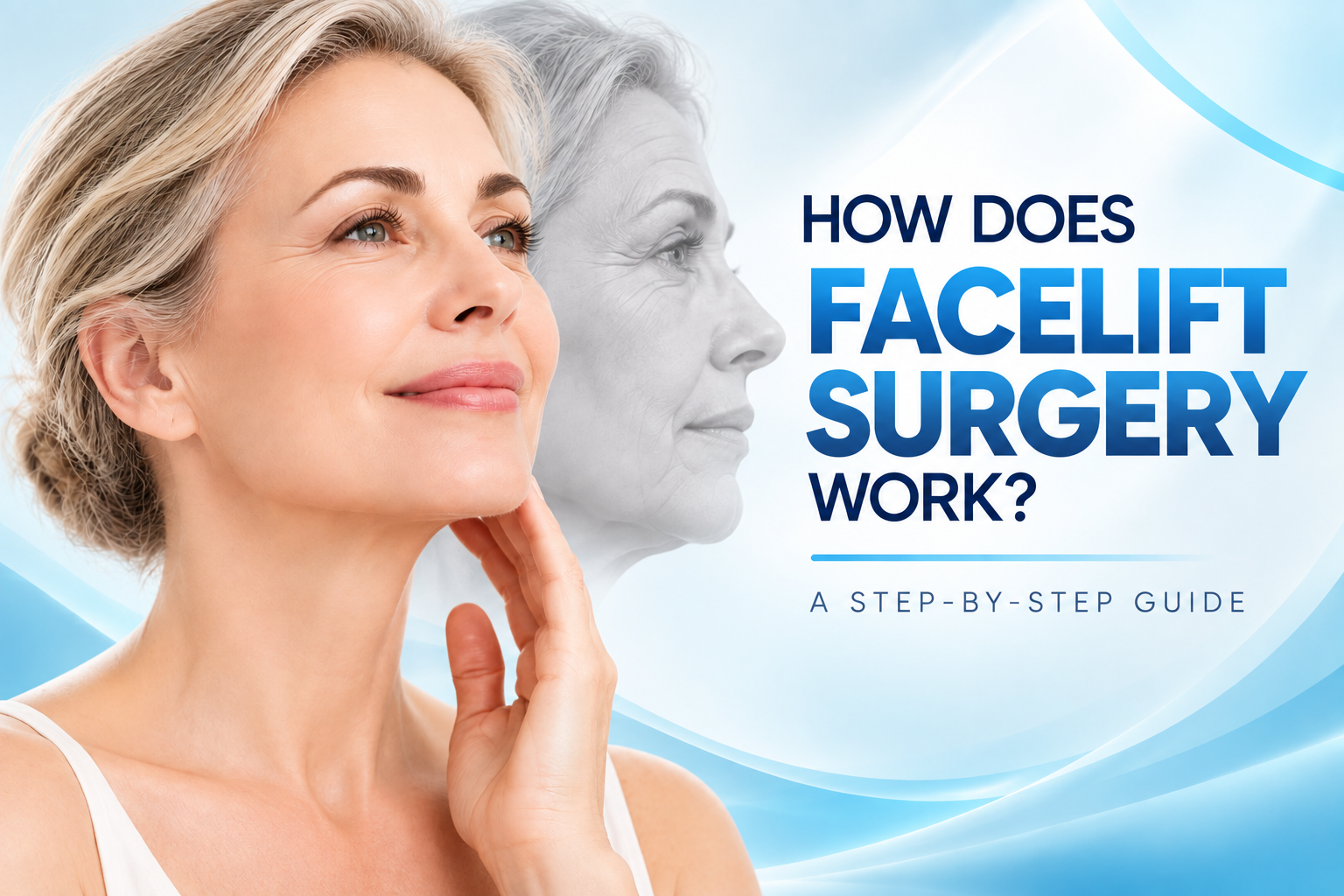
Facial aging is more than just wrinkles on the surface of the skin. Over time, the skin loses elasticity, facial fat changes position, supportive ligaments weaken, and deeper tissues begin to descend. These changes can lead to sagging cheeks, jowls, deeper facial folds, loose skin, and a less defined jawline.
For people looking for a more comprehensive and long-lasting approach to facial rejuvenation, a SMAS facelift is one of the surgical techniques commonly considered.
But what exactly is a SMAS facelift? How does it work? And how is it different from a traditional facelift?
This article explains the procedure, its potential benefits, recovery process, and the key differences between SMAS facelift surgery and more skin-focused facelift techniques.
1. What Is a SMAS Facelift?
SMAS stands for Superficial Musculoaponeurotic System. It is a fibromuscular layer located beneath the skin and subcutaneous fat of the face.
The SMAS plays an important role in supporting facial tissues and connecting the facial muscles with the overlying skin. As we age, this deeper support system can gradually become lax and descend along with other facial tissues.
This process may contribute to:
- Sagging cheeks
- Jowls along the jawline
- Deep nasolabial folds
- Loss of jawline definition
- Loose skin in the lower face
- Changes in facial contour
- Aging around the upper neck
A SMAS facelift is a surgical technique that addresses this deeper structural layer rather than simply tightening the skin.
During the procedure, the surgeon repositions and tightens the SMAS layer to restore support to the face. Excess skin can then be removed and carefully redraped over the repositioned tissues.
The goal is not simply to make the skin tighter, but to create a more youthful, balanced, and naturally defined facial contour.
2. Why Does the SMAS Layer Matter in Facial Aging?
One of the most important things to understand about facial aging is that it occurs at multiple anatomical levels.
When people notice sagging in the mirror, it may appear to be a skin problem. In reality, several deeper structures are also changing.
With age:
- Collagen and elastin production decreases.
- Skin becomes thinner and less elastic.
- Facial fat compartments may lose volume or shift downward.
- Facial ligaments may become weaker.
- Deeper soft tissues gradually descend.
- Bone structure can also change over time.
As a result, simply pulling the skin tighter may not fully address the underlying cause of facial sagging.
The SMAS acts as part of the structural framework of the face. By working with this deeper layer, surgeons can reposition facial tissues rather than relying entirely on skin tension.
This is one of the main principles behind a SMAS facelift.
3. How Is a SMAS Facelift Performed?
The exact surgical technique varies depending on the surgeon, the patient’s facial anatomy, the degree of aging, and the desired result.
Before surgery, the surgeon evaluates the face from multiple angles, paying particular attention to the cheeks, lower face, jawline, jowls, and neck.
Incisions are typically planned around natural anatomical areas, often beginning near the hairline and continuing around the ear. The exact incision pattern depends on the technique being used.
After making the incisions, the surgeon carefully elevates the skin to access the underlying tissues.
The SMAS layer is then tightened, repositioned, folded, or otherwise modified according to the surgical plan. Different surgeons may use different SMAS techniques based on the patient’s needs.
Once the deeper tissues have been repositioned, excess skin may be removed. The remaining skin is then gently redraped over the newly supported facial structure.
Importantly, the skin should not carry all of the lifting tension.
By creating support at a deeper level, the procedure aims to achieve facial rejuvenation without producing an excessively stretched appearance.
4. SMAS Facelift vs. Traditional Facelift: What Is the Difference?
The term traditional facelift is broad and may describe several different surgical approaches. However, when comparing a SMAS facelift with a more superficial or skin-focused facelift, the primary difference is the depth of treatment.
Traditional or Skin-Focused Facelift
A more superficial facelift primarily focuses on tightening loose skin and removing excess tissue.
This may improve certain signs of aging, particularly when skin laxity is relatively mild.
However, if deeper facial tissues have significantly descended, tightening the skin alone may not provide sufficient structural correction.
When excessive tension is placed on the skin, there is also a risk of creating an unnatural or overly pulled appearance.
SMAS Facelift
A SMAS facelift works at a deeper anatomical level.
Instead of relying primarily on the skin for lifting, the surgeon repositions the underlying SMAS layer before redraping the skin.
This can help improve:
- Lower-face sagging
- Jowls
- Jawline definition
- Cheek descent
- Deep facial folds
- Overall facial contour
Because the deeper tissues provide support, less tension may be required on the skin itself.
The objective is therefore not simply a tighter face, but a face that appears refreshed, naturally lifted, and better defined.
5. What Areas Can a SMAS Facelift Improve?
A SMAS facelift is generally designed to address age-related changes in the mid-to-lower face.
One of the most noticeable areas of improvement may be the jawline. As facial tissues descend, the once-defined transition between the face and neck can become less distinct. Jowls may develop along the lower jaw.
Repositioning deeper tissues can help restore greater definition to this area.
The procedure may also improve sagging in the cheeks and reduce the appearance of deeper folds caused by tissue descent.
For patients with significant neck laxity, a SMAS facelift may sometimes be combined with a neck lift or other neck-contouring procedure.
However, facelift surgery does not address every aspect of facial aging.
For example, pigmentation, fine surface wrinkles, certain eyelid concerns, or significant facial volume loss may require separate treatments.
6. Who Is a Good Candidate for a SMAS Facelift?
There is no universal age at which someone “needs” a facelift.
Two people of the same age can have very different facial structures, skin quality, genetics, and degrees of aging.
A SMAS facelift may be considered for individuals experiencing:
- Noticeable cheek sagging
- Jowls
- Loose skin along the lower face
- Reduced jawline definition
- Deepening facial folds
- Descending facial tissues
- Signs of aging that are difficult to address with non-surgical treatments
Candidates should generally be in suitable overall health and have realistic expectations regarding the outcome.
Smoking status, medications, previous facial procedures, medical conditions, and healing ability are also important factors that should be discussed during consultation.
7. Will a SMAS Facelift Look Natural?
This is one of the most common concerns among patients considering facelift surgery.
Many people want to look younger and more refreshed but do not want friends or family to immediately recognize that they have undergone surgery.
A well-planned facelift should aim to preserve the patient’s individual facial identity.
Rather than simply pulling the skin backward, a SMAS facelift focuses on repositioning deeper structures closer to a more youthful anatomical position.
This approach may help avoid the excessively tight or “windswept” appearance traditionally associated with poorly performed facelift procedures.
The goal should be:
You still look like yourself—just more refreshed, defined, and rejuvenated.
Final results, however, depend on anatomy, surgical technique, healing, and other individual factors.
8. How Long Can SMAS Facelift Results Last?
A facelift cannot stop the biological aging process.
After surgery, the face will continue to age naturally. However, because SMAS facelift surgery addresses deeper tissues rather than only tightening the skin, the improvement is generally intended to be relatively long-lasting.
The duration of results varies between patients and can be influenced by:
- Genetics
- Age
- Skin quality
- Sun exposure
- Smoking
- Weight fluctuations
- Lifestyle
- Surgical technique
- Postoperative care
Maintaining a stable weight, avoiding smoking, protecting the skin from excessive sun exposure, and following an appropriate skincare routine may help preserve the result.
Even years after surgery, patients may continue to look younger than they would have if they had never undergone the procedure, although individual outcomes vary.
9. What Is Recovery Like After a SMAS Facelift?
Recovery after a SMAS facelift is a gradual process.
During the first several days, swelling and bruising are common. Patients may also experience tightness, mild discomfort, numbness, or temporary changes in facial sensation.
These symptoms generally improve as healing progresses.
The surgeon may recommend keeping the head elevated, limiting strenuous physical activity, caring carefully for the incision areas, taking prescribed medications, and attending scheduled follow-up appointments.
Many patients become socially comfortable as swelling and bruising decrease, although recovery time varies depending on the extent of surgery and individual healing.
It is also important not to judge the final result too early.
Postoperative swelling can temporarily alter facial contours. The tissues need time to settle, and the appearance typically continues to refine over the following weeks and months.
10. What Are the Potential Risks?
A SMAS facelift is a surgical procedure and therefore carries potential risks.
Possible complications may include:
- Bleeding or hematoma
- Infection
- Swelling and bruising
- Delayed wound healing
- Changes in skin sensation
- Visible or widened scars
- Facial asymmetry
- Hairline changes
- Skin healing problems
- Nerve-related complications
- Anesthesia-related risks
Not every patient has the same risk profile.
A thorough consultation and medical assessment are therefore essential before undergoing surgery. Patients should inform their surgeon about existing health conditions, previous procedures, medications, supplements, allergies, and smoking or nicotine use.
11. SMAS Facelift vs. Non-Surgical Facial Rejuvenation
Non-surgical facial rejuvenation has become increasingly popular, including injectables and various energy-based skin-tightening treatments.
These treatments may be appropriate for people with mild signs of aging who are not ready for surgery.
However, non-surgical treatments and facelift surgery should not be considered interchangeable.
Non-surgical procedures may improve skin quality, volume, or mild laxity, but they generally cannot physically reposition significantly descended facial tissues in the same way surgery can.
For more advanced sagging, prominent jowls, or substantial skin laxity, surgical treatment may provide a more significant structural change.
The best treatment is therefore not necessarily the most aggressive or the least invasive. It is the treatment that appropriately addresses the patient’s anatomy and concerns.
12. Why Is a Personalized Consultation Important?
There is no single facelift technique that is ideal for every patient.
Some people have significant lower-face sagging but relatively good neck definition. Others may have pronounced jowls and loose neck skin. Another patient may have relatively little skin excess but substantial volume loss.
Before recommending treatment, the surgeon should evaluate factors such as:
- Skin elasticity
- Facial proportions
- Degree of tissue descent
- Fat distribution
- Jawline structure
- Neck anatomy
- Previous cosmetic treatments
- General medical condition
- Individual aesthetic goals
Depending on these factors, a SMAS facelift may be performed alone or combined with another procedure to create a more balanced result.
A personalized treatment plan is particularly important because successful facial rejuvenation is not about creating the same face for every patient. It is about preserving individual features while addressing the anatomical changes caused by aging.
13. SMAS Facelift at Vietnam Plastic Surgery & Dental
At Vietnam Plastic Surgery & Dental, facial rejuvenation should begin with a detailed assessment rather than a one-size-fits-all treatment plan.
The degree of skin laxity, facial tissue descent, jawline definition, neck condition, facial proportions, and individual aesthetic goals should all be evaluated before surgery is considered.
The objective of facelift surgery is not simply to make the face look tighter. A well-planned procedure should aim to create a harmonious improvement while preserving the patient’s natural characteristics.
For international patients considering plastic surgery in Vietnam, consultation is also an important opportunity to discuss the surgical plan, expected recovery period, postoperative follow-up, and recommended length of stay in Vietnam.
Conclusion: Is a SMAS Facelift Right for You?
A SMAS facelift is a surgical facial rejuvenation technique that works beyond the surface of the skin by addressing the deeper supportive tissues of the face.
Compared with a more skin-focused traditional facelift, the SMAS approach aims to reposition deeper facial structures, improve sagging, redefine the jawline, and create a more natural-looking rejuvenation without relying solely on skin tension.
However, no facelift technique is universally suitable for everyone.
The appropriate approach depends on your facial anatomy, degree of aging, skin quality, health status, and desired outcome.
If you are experiencing noticeable facial sagging, jowls, loss of jawline definition, or other age-related changes, a professional consultation can help determine whether a SMAS facelift or another facial rejuvenation option is more appropriate for you.
Considering a facelift in Vietnam? Contact Vietnam Plastic Surgery & Dental to discuss your concerns and receive an individualized treatment assessment.